


Montana Gov. Gianforte Tours Barrick’s Golden Sunlight Mine

[Click image to enlarge]
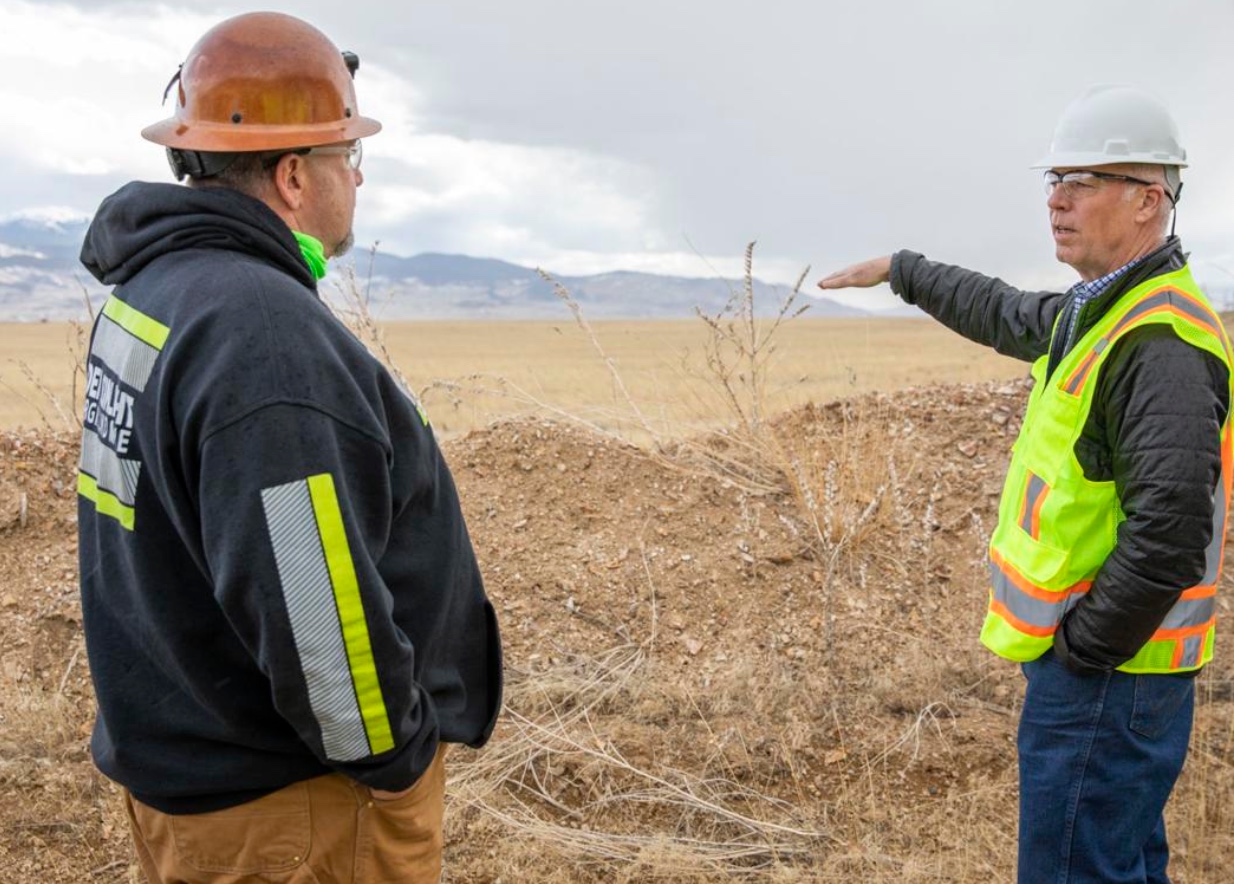
Gov. Gianforte, left, talks with chief engineer Clint Mortensen (Photo-Michael Cast)
[Click image to enlarge]
Gov. Greg Gianforte toured the Golden Sunlight mine near Whitehall on Friday, where miners hope a tailings reprocessing project will give the operation another 12 to 15 years of life.
Mine owner Barrick Gold Corp’s personnel touted the project as a win-win. They are currently awaiting approval of an environmental impact statement for a proposed amendment to the mine’s current operating permit from the Montana Department of Environmental Quality.
Golden Sunlight’s general manager, Chuck Buus, said the project would kill two birds with one stone.
Buus said the amendment would allow the mine to excavate the tailings from an unlined storage facility, reprocess the tailings on-site using a flotation separation method, deposit the benign rock back in the mine’s pit, and then ship the sulfur/gold concentrate to northern Nevada for a profit.
Approximately 26 million tons of tailings would be reprocessed. After excavation, the tailings facility footprint would be reclaimed for land uses such as grazing, recreation and wildlife habitat. All proposed activities would occur within the existing permitted disturbance boundary and would not include any new disturbance area.
Additionally, the project would employ 35 people directly by Barrick at the mine, and another 40 or so would be employed as contractors or in trucking, Buus said.
The low bidder out of seven applying for the project’s construction was Whitehall firm Smith & Sons Construction.
“They’re pillars of this community, and it’s great to have them helping us out,” Buus said.
Gianforte was impressed.
“At the point you’re cleaning up tailings, taking the potential pollutants out, giving us benign rock and generating jobs and revenue, I don’t see any downside to that,” Gianforte said.
“Thank you for your investment in Montana,” Gianforte added.
Currently, the mine is permitted to do inside construction and has been busy getting their mill ready to process the tailings. The excavation still requires a permit, which they hope to secure by September 15.
Dan Walsh, hard rock mining bureau chief for DEQ, during the tour said the environmental assessment has gone smoothly and it looks like that date is possible.
In the long-term, Barrick also hopes the project will prevent the company from having to treat contaminated tailings water in perpetuity, which its current permit requires.
“We have a closure plan. Before we were going to have a big water treatment plant, we were going to pump water forever, it was gonna cost a lot of money,” Buus said.
“After this, we’ll see how it’s working and we’re going to come back to Dan (Walsh) with another permit, getting rid of that water treatment plant if possible,” Buus added.
Patrick Malone, vice president of North American closures for Barrick, explained in an interview why he thought it would in fact be possible, beginning with why the mine currently has to treat water in perpetuity.
“The tails impoundment down there was unlined when it was originally constructed, and because of some of the concerns that were identified in the 80s, there’s water that’s leaving that tails impoundment, even today. It has to be pumped back here up to site. We also have water in the pit itself. As we turned off the pumps, the natural water levels start to rise, fills up the pit,” Malone said.
Malone hopes the tailings re-processing plan will change that reality.
“We’re getting rid of the cause of the contamination. We’re also using what we call a benign tailings material. All the bad stuff has been taken out of it, all the valuable stuff has been taken out of it. And those leftover sands or tails are put back in the pit. And when the water level recovers, instead of creating a pit lake, it stays down below the surface. And so you don’t have to treat that water anymore. That’s the idea. And then there’s also some evaporation that occurs. And so instead of that water going out and down gradient to the Jefferson Slough, it goes up and creates a sink, so that the water stays where it’s supposed to stay instead of moving out,” Malone said.
Whether or not the idea comes to fruition, the reprocessing project stands to at least clean a massive field of tailings currently sitting in an unlined facility.
The mine has long supported the Whitehall community with various charitable projects and employment opportunity. The operation switched from open-pit to underground by early 2016 and active mining ended in April 2019, resulting in the layoffs of around 150 employees over the time period.
Jim Loomis, the mine’s safety coordinator, has worked at the mine 17 years, and his father worked there for 26 years as well. Even his daughter did some time at the mine. The layoffs were hard on the community, he said.
“They were all pretty in despair when we were shutting down. And this kind of breathes some new life,” Loomis said of the reprocessing project.
Barrick personnel on the tour said the project will be a lesson to the industry about doing things right.
“We should be looking for opportunities to take abandoned mine lands and these former sites and redeveloping them and returning them to productive use,” Malone said.
For his part, Gianforte saw a lot to like at Golden Sunlight on Friday.
“I commend Golden Sunlight for doing a profitable reclamation project. That’s unique, and we should be doing it more,” Gianforte said.
Source: Montana Standard
About Barrick Gold
On January 1, 2019, a new Barrick was born as a result of the merger between Barrick Gold Corporation and Randgold Resources Limited. The merger has created a sector-leading gold company which owns five of the industry’s Top 10 Tier One gold assets Cortez and Goldstrike in Nevada, in the United States (100 percent); Kibali in the Democratic Republic of the Congo (45 percent); Loulo-Gounkoto in Mali (80 percent); and Pueblo Viejo in the Dominican Republic (60 percent) and two with the potential to become the gold assets of the first level: Goldrush / Fourmile (100 percent) and Turquoise Ridge (75 percent), both in the United States. With mining operations and projects in 15 countries, including Argentina, Australia, Canada, Chile, the Ivory Coast, the Democratic Republic of the Congo, the Dominican Republic, Mali, Papua New Guinea, Peru, Saudi Arabia, Senegal, the United States, and Zambia, Barrick has the lowest total cash cost position among its senior gold peers and a diversified asset portfolio positioned for growth in many of the world’s most prolific gold districts.
To stop by Barrick’s website, CLICK HERE
Be in-the-know when you’re on-the-go!
FREE eNews delivery service to your email twice-weekly. With a focus on lead-driven news, our news service will help you develop new business contacts on an on-going basis.
CLICK HERE to register your email address.