


Miners Participate in Simulated Rescue at CONSOL Energy’s Harvey Mine, Pa.

[Click image to enlarge]
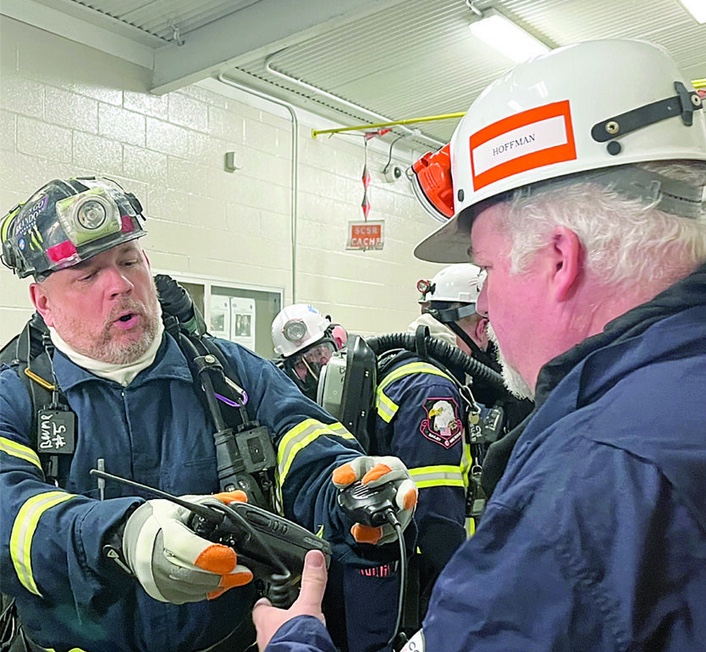
Radios are distributed to rescuers during a mine emergency response drill at Harvey Mine on Friday. (Photo: Karen Mansfield)
[Click image to enlarge]
A fire in an underground coal mine is among the most dangerous hazards miners can face.
On Friday, CONSOL Energy held a simulated emergency at Harvey Mine BMX Portal in West Finley to ensure that, if there is an emergency, responders will be prepared.
What heightened the intensity of the mine emergency response drill at the mine, located in the extreme southwestern corner of the state near the West Virginia border, was that only a handful of people — including Todd Moore, vice president of safety at CONSOL, who coordinated the event, and some from the WVU Mining Extension safety training team — knew initially that the fire was, in fact, not an actual disaster.
The surprise drill used smoke machines to simulate a fire caused by a diesel spill, which left at least one miner badly burned and as many as 170 others trapped 500 feet underground.
“You don’t ever want anything to happen, but we’re much better prepared than we’ve ever been if it does,” said Moore, who has worked for CONSOL for 43 years and coordinated the drill.
During the mock emergency drill, CONSOL Energy’s mine rescue and fire brigade teams were joined by local, state, and federal officials from the Mine Safety and Health Administration, the Department of Environmental Protection, Deep Mine Safety, Special Medical Response Team (SMRT) — a volunteer group of doctors, nurses, EMTs, and other professionals who respond to disasters, and WVU Mining Extension. They worked in real time to rescue the miners and put out the “fire.”
Moore said the drill’s purpose was to practice coordinating all parts of a rescue operation, including communication among response teams, CONSOL executives at the Canonsburg-based company, federal and state officials, and the news media. Ambulances were at the scene and helicopters were notified to be on standby.
“The men challenged with rescuing the miners got a chance to learn how they would need to react in a real mine disaster, and that’s why the drill is important,” said Josh Brady, director of mining and industrial extension at the WVU Academy for Mine Training and Energy Technology.
“You want to get all these things involved in a rescue squared away before it’s real. (CONSOL’s) going to review this and they’re going to see what was done. You’ve got to be ready and prepared for when it’s real. This is a training exercise, so it’s not about whether everybody really gets it right or wrong, it’s about whether they leave here being able to do it better tomorrow,” said Brady, a veteran of mine rescues including the Sago and Upper Big Branch mine disasters that occurred in 2006 and 2010, respectively.
According to Brady, the drill was going well, but problems did crop up that prevented mine safety and emergency medical personnel from immediately going into the mine — issues that ranged from having to check for gas levels in the mine and rescuers being unable to use the elevator to the mine, to a delay in tracking down radios for rescue crews.
At the command center, one Harvey Mine manager reported early on, “So where we are currently is there are 10 guys and a foreman in the 1-left section still that we know of, and one of the motormen is badly burned.” He noted the door was “glowing orange with smoke at the doors” and said rescuers on the surface had lost communication with the miners.
In the end, all of the miners were rescued, with four suffering injuries.
Moore said CONSOL last year introduced fire brigades, teams trained to fight fires and who work each shift in case of an emergency. The company also provides firefighting equipment underground.
Additionally, the miners had access to a fresh air bag that provides up to 96 hours of oxygen and scrubs carbon dioxide from the air.
The greatest benefit of the drill, Moore said, is the chance to learn from any mistakes.
Brady said one of the obstacles involved for rescuers is the fear factor.
“What you can’t do is mimic anxiety. That’s what not knowing this is a drill creates. You don’t know how these guys are going to respond in the moment,” said Brady.
The stakes are so much higher in an actual event. The more practice they get at that, the better,” added Brady.
Source: Wheeling News-Register
CONSOL Energy is a Canonsburg, Pennsylvania-based producer and exporter of high-Btu bituminous thermal coal and metallurgical coal. It owns and operates some of the most productive longwall mining operations in the Northern Appalachian Basin. CONSOL’s flagship operation is the Pennsylvania Mining Complex, which has the capacity to produce approximately 28.5 million tons of coal per year and is comprised of 3 large-scale underground mines: Bailey Mine, Enlow Fork Mine, and Harvey Mine. CONSOL also developed the Itmann Mine in the Central Appalachian Basin, which has the capacity to produce roughly 900 thousand tons per annum of premium, low-vol metallurgical coking coal. The company also owns and operates the CONSOL Marine Terminal, which is located in the port of Baltimore and has a throughput capacity of approximately 15 million tons per year. In addition to the ~622 million reserve tons associated with the Pennsylvania Mining Complex and the ~28 million reserve tons associated with the Itmann Mining Complex, the company also controls approximately 1.4 billion tons of greenfield thermal and metallurgical coal reserves and resources located in the major coal-producing basins of the eastern United States.
Be in-the-know when you’re on-the-go!
FREE eNews delivery service to your email twice-weekly. With a focus on lead-driven news, our news service will help you develop new business contacts on an on-going basis.
CLICK HERE to register your email address.