



Real Life Mining Stories with Leadership Lessons: Motivation Results from Communication

[Click image to enlarge]
[Click image to enlarge]
When I was a supervisor in a coal mine in 1979, I had one of my most difficult motivating tasks. The mine, Y & O Coal Company, where I worked as a production foreman, had since the mine’s inception been a captive mine. A captive mine is one whose coal is consumed by one customer. Long-term contracts had linked Cleveland Electric Illuminating (CEI) and Y & O Coal Company for over ten years. However, the Clean Air Act of 1977 reduced the amount of sulfur that power plants could emit. Therefore, CEI chose to buy western coal rather than install sulfur scrubbers in their smoke stacks to allow the burning of Southeast Ohio’s high sulfur coal.
All of these events were outside the control of my crew and me but we were impacted in a very significant way. Suddenly, our coal was being sold on the open market. The cost per man of producing coal became an issue when in the past little was said about it.
The company’s marketing department shifted its focus from dealing with one customer to dealing with dozens of potential customers, an obviously much more difficult task. Soon, the company made a decision to layoff almost half the union workforce and nine foremen. As our fortunes continued to decline, periodically, we found ourselves with no coal contracts and more layoffs. Coal contracts became synonymous with coal cars. As soon as we filled the coal cars that represented a contract, the union was laid off. The union often only worked three or four days a week during this time.
My crew and others at the mine began to believe that it was most advantageous to slow down the mining process. They said, “Why should we work so hard when the faster we mine the coal, the quicker we will be laid off.” Their logic certainly made sense on the surface. I had to help my crew understand that the most security possible for all of us would result from mining the coal as quickly as possible. The faster we mined the coal, the lower the price per ton of coal. The lower the price of coal per ton, the more contracts we would have had a chance of winning. It seemed like a backward logic to the men but the more we talked about it, the more sense it made. Everybody pitched in and the production rose dramatically.
Today, the work environment and customer demands are more complex than ever. Globalization, although disdained by some, is going to be the nature of business in the future. Leaders need to understand the complexity of their business and spend time explaining it to employees at all levels. Leaders and followers are truly in it together in all organizations. They should communicate in ways that reflect the reality of their common purpose. Secrets no longer make sense in today’s organizations.
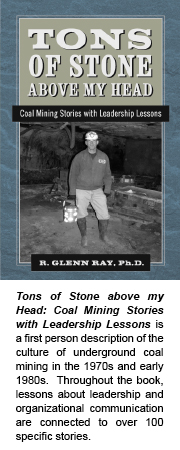
R. Glenn Ray, Ph.D. spent nine years working as an underground coal miner in Southeast Ohio from 1972 to 1982. In his book, Tons of Stone above my Head: Coal Mining Stories with Leadership Lessons (2010), Ray gives readers an intimate understanding of the challenge, excitement, danger, and pain common in the life of an underground coal miner.
His union classifications included ventilation man, rockduster, scoop car man, and roofbolter. For the last five years of his work in coal mines, he served as a production supervisor and track construction foreman. Along with over a hundred stories cataloging his experiences in all of these positions, his book offers leadership lessons he learned at the time or in retrospect.
R. Glenn Ray, Ph.D., is the president of RayCom Learning. To learn more about Ray’s new book, Tons of Stone above my Head: Coal Mining Stories with Leadership Lessons, or his leadership and communication development business, RayCom Learning, visit his Web site, CLICK HERE