


Lawmakers Revive Senate, House Coal Caucuses to Promote Industry
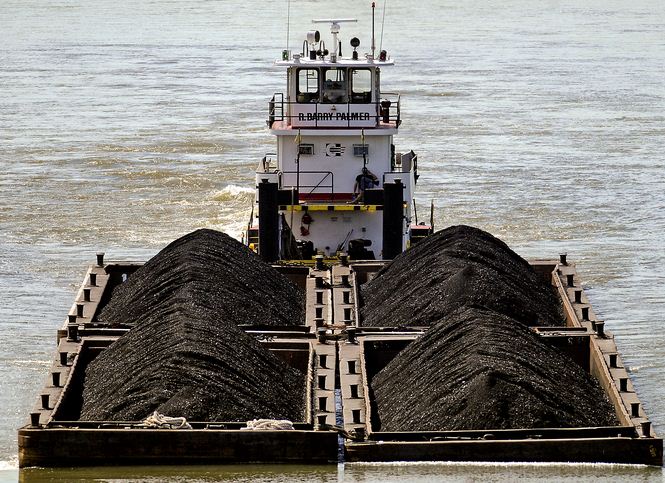
Four barges ship coal up the Monongahela River.
[Click image to enlarge]
It’s no secret that coal, facing stricter environmental regulations and greater competition from natural gas, is on the decline.
In Pennsylvania, where the coal industry provides almost 8,000 direct jobs, that hurts — and has political consequences.
To support the coal industry, the House Coal Caucus and Senate Coal Caucus were created. Rep. Jeff Pyle, R-Armstrong, heads the House caucus, while Sen. Gene Yaw, R-Lycoming, and Sen. John Wozniak, D-Cambria, co-chair the Senate caucus.
Although the caucuses do not directly produce legislation, Mr. Yaw said they help steer policy.
Recently, members of the Senate caucus threw their support behind House Bill 2354, now Act 175, signed by former Republican Gov. Tom Corbett. The act requires the Department of Environmental Protection to get approval from the General Assembly for plans regulating carbon dioxide emissions before they present them to the Environmental Protection Agency.
The House caucus, according to Mr. Pyle, is comprised of more than 70 members this year. Most members’ districts have workers involved directly with the industry in coal mining or power plants, or in peripheral industries like welding support services for mines, according to Mr. Pyle, who has headed the caucus for nine years. “For a lot of us, it’s a really important pillar of the economy,” he said.
By and large, the Senate caucus’ 19 members also have a direct interest in coal, according to Mr. Yaw, including senators with districts resting atop the state’s bituminous coal fields in the southwest and its anthracite fields in eastern Pennsylvania. Mr. Yaw was re-nominated to co-chair this term’s caucus at a Jan. 28 meeting during which 11 members of the caucus attended, including local Sen. Randy Vulakovich, R-Shaler. Mr. Yaw has co-chaired the caucus since 2013.
Pennsylvania was the fifth largest coal producer in 2013, yielding about 51 million tons and providing about 5 percent of the nation’s coal, according to the U.S. Energy Information Administration.
Mining in the state accounted for about 5,500 jobs underground and 2,400 on the surface in 2013, according to the EIA. Those numbers were down more than 10 percent from 2012, when the mining industry employed almost 9,000 people in the state.
And for the first time in two decades, coal producers across the country churned out less than a billion tons, according to the EIA.
Members of both caucuses have had the opportunity to look first-hand at the mines that are under pressure from new energy resources and regulations like the Environmental Protection Agency’s Clean Power Plan, which is mandating that the country’s power plants slash carbon dioxide emissions by 30 percent by 2030.
In the past, members of the Senate caucus visited Consol Energy Inc.’s Bailey Mine Complex in Waynesburg, Greene County, a trip hosted by Consol, the Pennsylvania Coal Alliance, and Bristol, Va.-based Alpha Natural Resources.
“It’s about the education,“ said John Pippy, CEO of the Pennsylvania Coal Alliance. “It’s usually legislators who want to learn more information…. It’s really dependent on the interest and desire of the members.” The Alliance has participated in a number of events for the caucuses, including mining tours and educational breakfasts.
Mr. Pyle said that he expects a similar tour for the House caucus this year.
A number of other state caucuses exist. Among them, Mr. Pyle is active on the steel, oil and gas, anti-abortion and firemen’s caucuses.
Mr. Yaw, elected to the state Senate in 2008, also serves as chairman of the Senate’s Environmental Resources and Energy Committee.
“When you go down a thousand feet and then go a couple miles underground horizontally and find out the conditions people work under ... you have a different appreciation for what these people do on a daily basis,” Mr. Yaw said. “It gives you a different perspective when you start to talk about legislation.”
— By: Braden Kelner, Pittsburgh Post-Gazette