




Avondale: The Disaster that Changed Everything About Anthracite Mining

The Avondale Mine Memorial Garden site.
[Click image to enlarge]
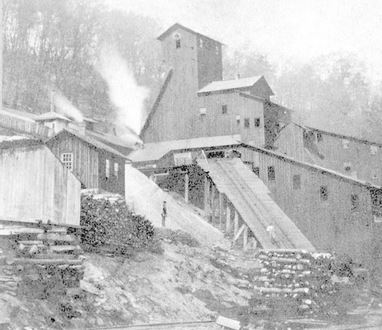
The Avondale Coal Breaker in 1868; destroyed by fire Sept. 6, 1869.
[Click image to enlarge]
Most of the coal mines that once dotted Northeastern Pennsylvania’s landscape are long gone, leaving us with only memories of the hardworking men that toiled underground.
One of the most unpleasant memories is that of the Avondale Mine Disaster, which Sept. 6 marks the 150th anniversary of the loss of 110 men and boys — the single highest number of lives lost in an anthracite mine disaster in American history.
Steve Kondrad and his wife, Mary Beth McMonigal Kondrad, know “The Avondale” well and they have experienced its tragic results personally.
Mary Beth’s second great-grandfather, John D Evans, perished during the disaster. He left behind his wife Mary and five children. John D. Evans rests among his fellow Avondale miners at the Washburn Street Cemetery, Hyde Park, Scranton.
”Preserving the history and heritage of our anthracite coal miners is of utmost importance,” Kondrad said. “The sacrifices they made, working long hours in extremely dangerous working conditions, to provide for their families should never be forgotten.”
Kondrad said commemoration ceremonies will be held for the 150th anniversary of the disaster. A roll call of all victims will be read aloud in the Washburn Street Cemetery and at the mine site in Plymouth Township. Once again their names will be heard among the living.
Kondrad, who heads the Plymouth Historical Society, said the Avondale Mine Disaster was a milestone event in anthracite mining history in America.
Kondrad notes that because of the terrible loss of life at Avondale, the first mine safety legislation laws were passed in May of 1870.
From that point on, all newly constructed coal breaker buildings had to be built a safe distance away from the mine opening. Also, all mines must have at least two means of exit and be ventilated by an external ventilation fan.
Luzerne County Council has proclaimed Sept. 6, 2019, as “Avondale Day in Luzerne County.”
Sept. 6, 1869
The great disaster at Avondale occurred on Monday morning, Sept. 6, 1869. The mine, which was operated by the Delaware Lackawanna & Western Rail Road, was located in Plymouth Township, below Avondale Hill.
The summer of 1869 saw a lengthily and often bitter strike by local miners. By the time August rolled around, the miners’ families were in a desperate situation. Many families were near starvation.
Separate negotiations between representatives for the miners and mine owners were conducted throughout towns in northeastern Pennsylvania. On Aug. 26, 1869, miners in the Hyde Park section of Scranton voted to accept the mine owner’s terms and to return to work. This agreement with the miners from Hyde Park, who were predominately of Welsh decent, raised tensions between other ethnic groups, particularly Irish mine laborers, who wanted to continue the strike.
As a result of “The Scranton agreement,” the DL&W announced a company-wide startup of all their mines for Sept. 2. Since their Sloan Colliery in Scranton recently closed, the company offered men work at their Avondale Colliery. Miners were given free rail transportation to and from Avondale, while others from Hyde Park boarded with friends or family who lived near the colliery.
On Monday Sept. 6, 1869, the absolute worst fear of every miner’s family occurred. The wooden coal breaker, which was situated directly above the one and only mine shaft, caught fire. As the fire raged through the wooden building, their loved ones were trapped over 240 feet below in the mine.
As soon as word had spread about the fire at Avondale, a panic stricken crowd hurried to the mine site. Below ground, the miners did their very best to try to wait out the fire. They made their way to the farthest points in the mine chambers, away from the shaft and built a barricade, to conserve precious good air. Unfortunately, the fire above eventually filled the entire mine with deadly gases. The trapped miners had no chance for survival.
When the fire was finally extinguished, David Jones and Thomas Williams volunteered to descend the mine shaft to search for the trapped miners. When they did not signal to be brought to the surface, other volunteers went down to check on them.
Both Jones and Williams were found overcome by deadly carbon monoxide. They sacrificed their lives in that noble rescue effort. Later, when news spread that David and Thomas perished, fear turned to horror. The following day, a large steam driven fan was used to circulate fresh air throughout the mine. As air in the mine began to clear, rescue efforts turned to recovery.
Eventually, all 108 victims were brought to the surface. Newspaper accounts described the horrid spectacle. The news of this terrible tragedy circulated throughout the world. Since 69 of the 108 miners were Welsh, the news of the disaster struck many families and mining communities in Wales. The Avondale Disaster was known as the Welsh Tragedy.
In Northeastern Pennsylvania, entire communities were grief stricken. On Sept. 8, the mayor of Scranton requested that citizens of Scranton should close their places of business and keep them closed until the Avondale victims were buried. Similar acts of respect were carried out throughout the region.
On Sept. 9 and 10, 61 victims were buried at the Washburn Street Cemetery, Hyde Park section of Scranton. A number of victims were buried side by side at Shupp’s Cemetery in Larksville. Eight Catholic victims were buried at the Darling Street Cemetery, Wilkes-Barre. The remainder of victims were buried at cemeteries in Forty Fort, Hanover Green, Pittston, Harveys Lake and Tamaqua.
After much deliberation, the official coroner’s inquest found that the fire was caused by stray embers from the underground ventilation furnace which ignited wooden planking near the top of the mine shaft. The verdict was and still is controversial, as arson was a very feasible possibility.
By: Bill O’Boyle, Times Leader