





Yellowstone Mining Ban Clears U.S. House Committee
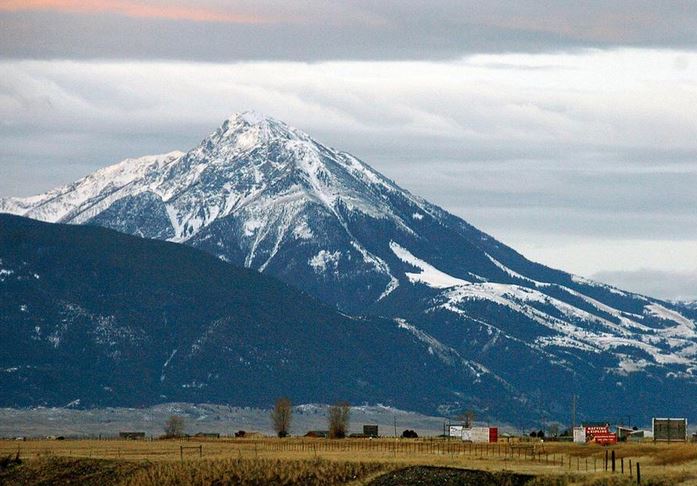
This Nov. 21, 2016, fphoto shows Emigrant Peak towering over the Paradise Valley in Montana north of Yellowstone National Park.
[Click image to enlarge]
A bill permanently banning new mining claims in the mountains north of Yellowstone National Park has advanced to the floor of the U.S. House.
The House Natural Resources Committee passed the Yellowstone Gateway Protection Act on Wednesday on a 28-4 vote.
The bill, sponsored by U.S. Rep. Greg Gianforte, R-Montana, would permanently withdraw mineral rights from 30,000 acres of public land in the mountains east of the Paradise Valley near where mining companies have shown interest in exploring.
It would make permanent a temporary ban ordered by the Obama administration in 2016. Last week, the U.S. Forest Service officially recommended extending that ban to last 20 years. Such a moratorium can only become permanent through legislation.
In a statement issued after the vote, Gianforte said a temporary prohibition on new claims won’t be enough to protect the area.
“Instead, Montanans need a permanent, legislative solution to resolve this once and for all,” Gianforte said.
Passage out of the House committee sets the bill up to go to a vote of the full House, but no such vote is scheduled. It also makes it more likely that it might be attached to a larger legislative package.
U.S. Sen. Jon Tester, D-Montana, has introduced a similar bill in the Senate. The Senate Committee on Energy and Natural Resources has scheduled a markup of the bill for Tuesday. Tester said in a statement that he hopes that bill will clear committee.
“Today we took a step in the right direction and I look forward to passing this bill out of the Senate committee next week,” Tester said. “It is time for the whole delegation to get behind this important, bipartisan effort to permanently protect the front doorstep of Yellowstone Park.”
U.S. Sen. Steve Daines, R-Montana, sits on the committee that will consider the bill. He is not a sponsor of the bill, but he said in a recorded statement Wednesday that he fought to ensure the committee would take it up. He added that he’s “very pleased to announce that next week our committee is going to be voting on this important bill.”
Supporters celebrated the news that the bill cleared the House committee. Bryan Wells, a business owner and founding member of Yellowstone Gateway Business Coalition, thanked the delegation for their support in a statement.
“We are just extremely grateful for the bipartisan cooperation demonstrated by our entire delegation,” Wells said.
Members of conservation groups and the Park County Commission also cheered the decision.
The call for a ban on new mining claims in the mountains east of the Paradise Valley began after two exploratory drilling proposals surfaced. One was proposed near the border of Yellowstone. The other was proposed farther north, near a narrow canyon called Emigrant Gulch, behind Chico Hot Springs.
Opponents of the projects worry they’ll lead to large-scale mines with the potential to harm water quality and the region’s tourism-based economy. The mining companies disagree, arguing that it’s too early to worry about a large mine and that mining can be done safely.
The withdrawal area in the bill is split between public lands surrounding the two proposals, which the mine opponents believe will hamper a company’s ability to expand.
Tester introduced the Senate bill in April 2017. Gianforte followed suit on the House side in December 2017. Republican U.S. Sen. Steve Daines has said he supports the withdrawal but has not signed on as a sponsor of either bill.
On Wednesday, Gianforte told the committee that it would protect an area unsuited for mining and that it’s backed by local residents who worry about the impact of mining on the region’s tourism-based economy.
“I urge you to honor their wishes and I urge you to protect Paradise Valley,” Gianforte said.
Several amendments to the bill were offered by U.S. Rep. Paul Gosar, R-Arizona, who opposes the idea behind the bill. His amendments sought to limit mineral withdrawals nationwide and one that would have limited the length of the withdrawal to seven years.
“Making withdrawals permanent ignores future technological advancements that may lead to the extraction of critical and strategic minerals once thought to be unattainable,” Gosar said.
Each of Gosar’s six amendments were either voted down or dismissed by the committee’s chairman, U.S. Rep. Rob Bishop, R-Utah.
Source: Sidney Herald
Be in-the-know when you’re on-the-go!
FREE eNews delivery service to your email twice-weekly. With a focus on lead-driven news, our news service will help you develop new business contacts on an on-going basis.
CLICK HERE to register your email address.