





WVU Engineer Aims to Improve Profitability, Flexibility of Coal-fired Power Plants Using AI
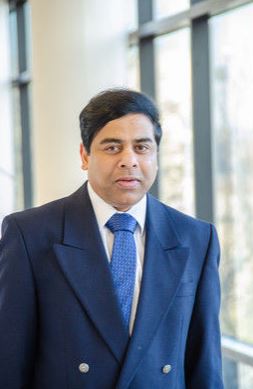
Debangsu Bhattacharyya, GE Plastics Material Engineering Professor of chemical and biomedical engineering at WVU.
[Click image to enlarge]
One West Virginia University chemical engineer is tapping into artificial intelligence to prolong the lives of power plant boilers.
Debangsu Bhattacharyya, GE Plastics Material Engineering Professor of chemical and biomedical engineering, received a $2.5-million U.S. Department of Energy grant to develop an online monitoring tool, using AI, for boiler systems at coal-fired and natural gas power plants.
Due to frequent and rapid loading, power plants are subjected to excessive creep and fatigue damages, which often lead to the failure of critical boiler components, Bhattacharyya said. This causes power plants to operate inefficiently.
Here’s how power plants work: Coal or natural gas is combusted inside to produce high-pressure steam that is then used in a steam turbine to generate electricity. A boiler incorporates a furnace to burn fuel and generate heat, which is transferred to water to make steam.
“The boiler is at the heart of the power plant,” Bhattacharyya said. “During startup, the boiler is gradually heated up increasing the steam temperature and pressure to their nominal values.”
With power plant boilers, there’s a lot of starting up and shutting down.
Depending on the length of the idle time before the startup is initiated, startups can be categorized as hot, warm or cold startups. Cold startups can cause significantly more damage to the boiler health in comparison to hot or warm startups. During shutdown, the boiler is gradually cooled and the steam pressure is decreased.
Many power plant boilers start up and shut down several hundreds of times a year.
This is where AI can play in role, in predicting the behaviors of the boilers by “learning” the inner workings of the system, Bhattacharyya said.
“AI models will be used to describe the complex phenomena in the boilers that are time-varying,” he said. “For example, external fouling of boiler tubes by fly ash and slag is an extremely complex phenomenon being affected by various operating conditions such as the gas flow field, coal and ash particle shape and size distribution and hardware design.”
A tool to monitor the online health of the boiler can be developed to understand the impacts of load-following and can eventually help plants develop advanced process control strategies for improved flexibility, higher profitability and reduced forced outage without compromising safety or reliability, Bhattacharyya said.
“As the system learns, it eventually keeps improving the estimation accuracy,” he said.
The project is part of a larger initiative from the DOE’s Office of Fossil Energy that allocated $39 million toward a total of 17 research projects aimed at improving the reliability, performance and flexibility of the nation’s existing coal-fired power fleet.
Bhattacharyya’s model will be tested at Barry Power Plant, a coal- and natural gas-fired electrical generation facility in Alabama.
“Even though each boiler is different, the framework proposed can be readily adapted to the monitoring of practically any power plant,” he said. “A key goal of the project is to develop the framework so that it is easy to understand and implement for broader acceptability by and applicability to large number of power plants.”
About West Virginia University
As a land-grant institution, the faculty, staff and students at West Virginia University commit to creating a diverse and inclusive culture that advances education, healthcare and prosperity for all by providing access and opportunity; by advancing high-impact research; and by leading transformation in West Virginia and the world through local, state and global engagement.
To stop by WVU’s website, CLICK HERE
Be in-the-know when you’re on-the-go!
FREE eNews delivery service to your email twice-weekly. With a focus on lead-driven news, our news service will help you develop new business contacts on an on-going basis.
CLICK HERE to register your email address.
Copyright © 2019 Mining Connection LLC. All rights reserved. This material may not be published, broadcast, rewritten, or redistributed without permission.
For licensing permission, .(JavaScript must be enabled to view this email address)