






Ontario Promises to Move with Speed on Permitting New Mines, Canada
Government of Ontario is promising a 24-month max delivery time when it comes to reviewing and permitting advanced exploration new mine projects in Ontario.

[Click image to enlarge]
[Click image to enlarge]
The Ford government’s push for ‘one project, one process’ when comes it comes to expediting new mine approvals in Ontario is no longer just bold talk, according to Energy and Mines Minister Stephen Lecce.
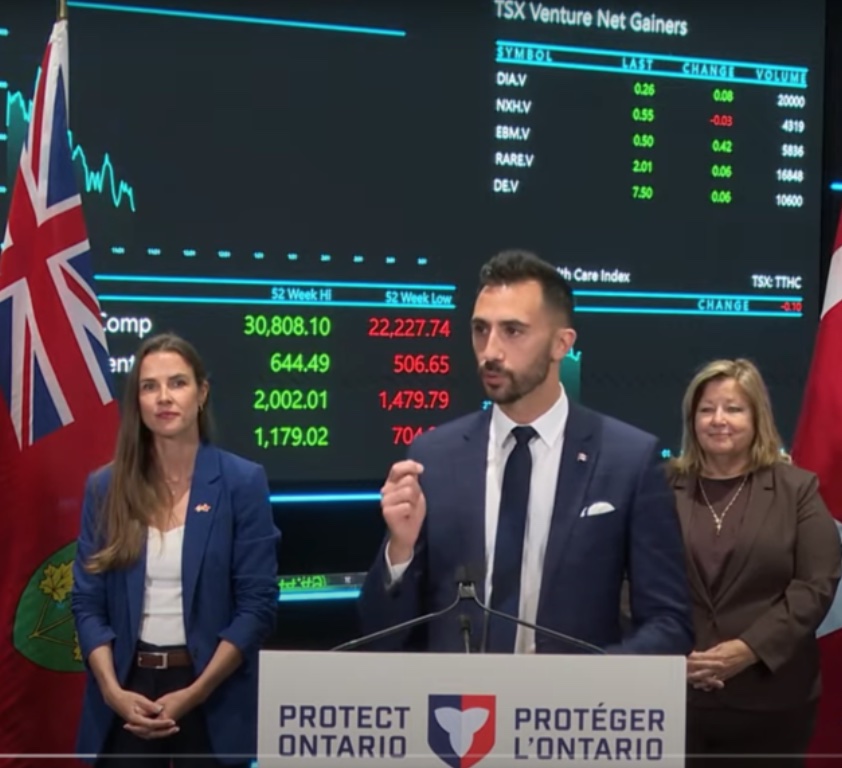
Lecce chose the big board at the TSX-V in Toronto on Friday as the backdrop for a flag-waving, throw-down-the-gauntlet speech to proclaim that the province’s latest red tape-cutting measure, designed to advance mines into production more quickly, is “now the law of the land.”
In government vernacular, it’ll be known as the 1P1P (One Project, One Process) framework.
The province said mining companies can now apply to have advanced exploration and mine development projects designated under the 1P1P framework. The first designation is expected to be announced in the coming weeks.
A dedicated Mine Authorization and Permitting Delivery Team, under Lecce’s ministry, will be the single point of contact to coordinate all necessary provincial approvals.
“The problem is well socialized. It takes too long to do big things in this country,” said Lecce.
His ministry is promising a 24-month max delivery time when it comes to reviewing and permitting advanced exploration new mine projects in Ontario.
Lecce said the Ford government is making good on an aspirational goal of being the fastest permitting mining jurisdiction in the world, improving from an average timeframe of up to 15 years, the second slowest in the OECD (Organisation for Economic Co-operation and Development).
The ministers said nothing about how their new and improved approvals will mesh with that of Ottawa’s much criticized regulatory process on reviewing big mining projects, such as the Eagle’s Nest nickel project in Ontario’s Ring of Fire.
The one-window, inter-ministerial, SWAT-team solution had been promised by previous provincial governments, in decades past, when it came to reviewing and approving new mines. But their best communicated intentions never filtered down to a siloed bureaucracy.
Because of the Trump administration’s tariff policies, Lecce and Red Tape Reduction Minister Andrea Khanjin are pledging things are going to change to help protect Canadian sovereignty.
Lecce’s proclamation comes amid disconcerting news of carmaker Stellantis shifting production from its Brampton plant to the U.S.
Ontario said its policy and program will make the permitting process less onerous, more transparent and will bring certainty to mining proponents that will attract investment to Ontario.
“We’ve brought forth a vision. Slash the red tape. Move with speed. Do it in partnership with Indigenous and municipal communities. But get on with building,” said Lecce.
Ten mining projects in Ontario, he said, are currently in the permitting queue.
Lecce said Canada is lagging behind other global mining jurisdictions.
Western Australia stamps the approvals to open mines in less than eight months; the European Union does it in less than ten months.
Lecce contends Ontario can be the “gold standard” as a deliverer of ethical resources with high human rights, labor, and environmental standards.
Red Tape Reduction Minister Andrea Khanjin, said their coordinated, streamlined approach will eliminate individual ministry operating silos.
“Permitting should not be a maze. It should actually be the launch pad for an entire economy … because government processes should serve people, not delay them and get in their way,” said Khanjin.
The policy “signals a meaningful shift for all parties, including First Nations,” said supporter Karen Restoule, director of Indigenous Affairs with the Macdonald-Laurier Institute, a public policy think tank, and should lead to more constructive dialogue.
For a permit system that had “grown increasingly complicated — and that’s an understatement — that complexity has made meaningful consultation harder, not easier,” she said.
Restoule believes this process will avoid government duplication and will create a more coherent path to help the government adhere to its duty to consult. It will open the door to more constructive dialogue for regulators to listen, she said, and better understand concerns rather than just filling in checkboxes.
“This is how we build trust,” said Restoule.
Source: Timmins Today
Be in-the-know when you’re on-the-go!
FREE eNews delivery service to your email twice-weekly. With a focus on lead-driven news, our news service will help you develop new business contacts on an on-going basis.
CLICK HERE to register your email address.