



Mining Officials Assess Progress on New Underground Survival Equipment
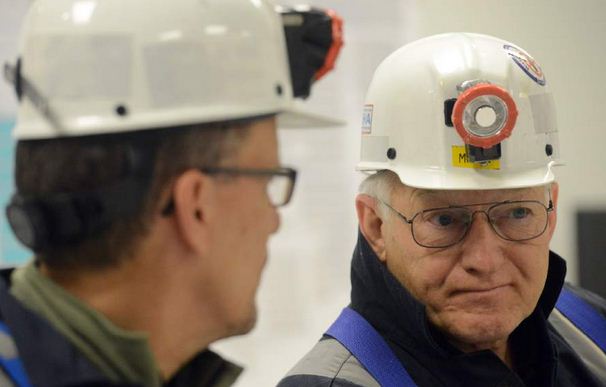
U.S. Secretary of Labor Thomas E. Perez, left, and Assistant Secretary of Labor for Mine Safety and Health Joseph A. Main.
[Click image to enlarge]
Kevin Stricklin and Joe Main can rattle off a list of mine disasters that share a common ending: Miners trapped underground lived through an initial fire or explosion, but they could not get out or weren’t able to survive long enough to be rescued.
“We all know that their best chance of survival is to get out of the mine, but they need an alternative,” said Stricklin, administrator for coal mine safety and health at the Mine Safety and Health Administration.
Today that alternative is a boxlike shelter — mandated after the 2006 Sago Mine disaster in West Virginia killed 12 men underground — that is meant to keep miners using rescue breathers alive for a few days. Teams of engineers from federal agencies, universities and the private sector are working on the next generation of equipment to improve the breathing apparatus and shelters.
“It’s a horrible decision to have to make 5 miles in,” said Main, an assistant Labor secretary who leads MSHA, which is part of the Labor Department. “Do I crawl in a box and wait for the cavalry that could ... take a long time to get there?”
Main and Stricklin were among dozens of federal officials, mining leaders, researchers and contractors who gathered Thursday in South Park to get an update on the work of those engineering teams. MSHA faces several deadlines in the next few years to approve new self-contained rescue breathing equipment and designs for new refuge shelters.
“The goal was to get us on a thinking path here,” Main said of the meeting at the National Institute of Occupational Health’s offices in the government’s Bruceton Research Center.
NASA researcher Dave Bush outlined a system that uses cryogenics to supply compressed air to trapped miners while controlling temperatures around them. Former television producer Kevin Juergensen of Somerset County is applying scuba technology to rescue breathing apparatus. The Navy is working on prototype masks that allow people wearing them to communicate with one another.
“If we can lower the work of breathing, hopefully people will remain calm ... and get out,” said Rob Moran, president of Florida-based Mine Survival Inc., which is developing a lightweight vest miners could wear that would provide 3 1⁄2 hours of air.
A collapse in U.S. coal markets during the past five years has led to sweeping layoffs, mine closures and bankruptcy filings by many of the top producers. The financial strain has slowed investment in research and development, said Braden Lusk, a mine engineering professor at the University of Kentucky.
He said he is worried MSHA will not meet a December 2018 deadline to approve new refuge structures, citing a debate over some of the technical requirements and slow development by companies.
“There’s not a real big light at the end of the tunnel that these will be approved,” he said.
Main acknowledged the downturn and challenges but predicted the deadlines will motivate action.
“The new generation (of equipment) has to be built,” he said, noting that approvals for all self-contained rescue breathing devices on the market will expire in January.
- By: David Conti, Trib Live