





Coal’s Black Cloud Starting to Turn Blue
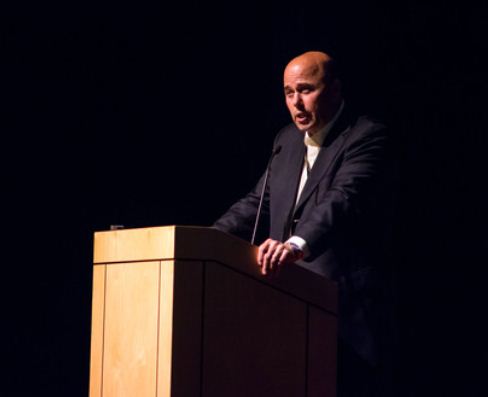
Kemal Williamson, President – Peabody Energy speaks at the Rocky Mountain Energy and Infrastructure Summit.
[Click image to enlarge]
“Coal is the reason why U.S. energy rates have been the lowest on the globe,” said Kemal Williamson, President – Americas, Peabody Energy. Even though data and facts back up Williamson’s statement, his background, which he admits, has given him a slightly different view on energy.
“I’m a third generation coal miner, so I am going to have some different views than other energy groups,” Williamson said.
Peabody Energy is the world’s largest private-sector coal company and a global leader in sustainable mining and clean coal solutions, according to their company’s website. Peabody serves metallurgical and thermal coal customers in nearly 25 countries on six continents. Williamson, who oversees the United States, continued with an example of how his views may be different due to a motivation to “change some future policy.”
Williamson said Wyoming and North Dakota are leaders in fueling the nation and, along with other states, doesn’t plan to slow down.
“Wyoming is demonstrating the type of leadership, alongside other states like Louisiana, North Dakota, certainly Texas and others, in generating what we are finding is a ground swell of opposition to regulatory overreach in a number of different areas,” Williamson said. “Land use, water use and certainly a topic that is near and dear to our hearts energy regulation.”
Williamson said there is some legitimacy with both sides of the energy argument, but did say the push pull and legal fight will result in issues and inconveniences to energy customer.
He cited the EPA Rule 111D , which is a reduction in CO2 in the power sector by 30% from 2005 baseline levels. According to Ayres Law Group, LLC, the presidential memorandum issued in June 2013, directed EPA to issue regulations of carbon pollution from existing power plants under section 111(d) of the Clean Air Act. President Obama requested EPA to issue a proposed rule by June 2014 and a final rule by June 2015.
“It’s a slightly different approach than we are seeing where it is system based and not plant by plant based as required under the Clean Air Act in law in most of the states in this country,” Williamson said. “Because implementation is going to wind up in the states, it assumes legal authority today that the states do not have and simply does not exist.”
He continued saying the system based approach will encroach on the state’s authority and could “seriously” undermine the grid when you factor in interchanging grids and states.
“When you have utilities operating across multiple states it get’s very confusing how that interaction is going to take place,” Williamson said.
According to Williamson the regions have transitioned from an economic dispatch to an environmental dispatch and is applied by the federal government.
“So even if enacted, these limits would have minimal to no benefit under climate models if we consider what is already in place today,” Williamson said.
Talking specifically about coal, Williamson questioned the administration’s agenda further when compared to policies in leading global nations like Japan and Australia. He believes there is no basis for law and because of the ongoing litigation, it will take an enormous amount of time and resources from the coal industry rippling into other energy sectors.
Williamson spoke hypothetically about the EPA and the proposed 111D, using the EPA’s facts as his foundation.
“If this regulation is fully implemented and we fast forward to 2030,” Williamson said. “We are going to have a .18, that’s zero point one eight, percent reduction in global CO2 output through that time period. We are going to have a resulting .01, that’s zero point zero one, degrees celsius in lowering global temperature.”
Williamson continued listing the long term changes to the earthly elements.
“The global sea level rise has been very topical, well it’s going to be one-third the thickness of a dime. That is what these regulations will do if the coal industry is to take the brunt of the force of the EPA on 111D,” Williamson said. “So we are being asked for a lot of pain with little to no gain.”
So why is the coal, and other energies, putting up with this? Williamson thinks there are a couple reasons why. First is political leadership. Only for the coal industry, the political leadership is needed in the climate world, not so much the Middle East like oil and gas.
“So if you believe that is material, than that’s where we are headed,” Williamson said. “If you don’t believe it and you believe there are some costs associated with that, than I would encourage you to stand up to some opposition. And that’s what we see on this particular side.”
Williamson said opposition is mounting and continuing to gain support in the house, senate and state levels.
“We’ve got 20-plus state legislatures asking the EPA to withdraw the rule,” Williamson said. “We’ve got 20-plus state legislatures including Wyoming passing resolutions in opposition. It’s not all one sided.”
Another interesting development in the political realm is the development of Coal Blue. A group of democrats in coal centric states have banded together in 2013 to inform and educate the public on energy diversity, with coal being the main part of that diversity. However the changes that could occur with unions and labor groups may have been the motivator with the public, rather than the energy resource itself.
“We see things on the labor movement where they are stepping up, where the Obama administration was supported very heavily in the past by labor unions,” Williamson said. “But it’s not just about these mining and energy jobs its about many different industries these rules will cut across.”
Williamson rattled off a list of state attorney generals, governors, lawsuits, public utility commissions and other entities supportive to further demonstrate the issue is bipartisan and not resolved.
Looking at the state-by-state costs of energy, Williamson pointed out the east and California west coast share similar energy prices, which tend to consistently be one of the higher prices in the country. Whereas the Pacific Northwest has historically produced the lowest costs and prices in energy. Williamson believes these low prices are because of the balanced energy approach.
“The lowest cost of energy in this country is in the Pacific Northwest. The state of Washington, the state of Idaho, Oregon, why do you think it’s so low? Hydro,” Williamson said. “Now certainly it is all things, but a balanced portfolio is the key.”
At the end of the day, that’s all energy is looking for. Whether is it coal, hydro, wind, oil or gas, they are almost literally longing for an intelligent approach to an energy equilibrium. To have regulators and citizens understand that every state has different natural resources and cultures.
“As a coal industry, all we want is an even playing field where we can compete straight up on the economics,” Williamson said.
— By: Jason Spiess, Fargo Business Examiner