



Primary Energy Consumption in U.S. Hits All Time High
[Click image to enlarge]
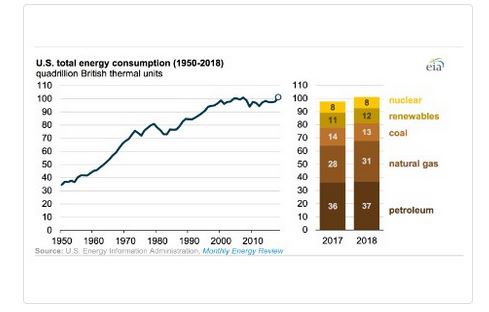
Primary energy consumption in the United States reached a record high of 101.3 quadrillion British thermal units (Btu) in 2018, up 4 percent from 2017 and 0.3 percent above the previous record set in 2007. The increase in 2018 was the largest increase in energy consumption, in both absolute and percentage terms, since 2010.
Consumption of fossil fuels — petroleum, natural gas, and coal — grew by 4 percent in 2018 and accounted for 80 percent of U.S. total energy consumption. Natural gas consumption reached a record high, rising by 10 percent from 2017. This increase in natural gas, along with relatively smaller increases in the consumption of petroleum fuels, renewable energy, and nuclear electric power, more than offset a 4 percent decline in coal consumption.
Petroleum consumption in the United States increased to 20.5 million bpd, or 37 quadrillion Btu in 2018, up nearly 500 000 bpd from 2017 and the highest level since 2007. Growth was driven primarily by increased use in the industrial sector, which grew by about 200 000 bpd in 2018. The transportation sector grew by about 140 000 bpd in 2018 as a result of increased demand for fuels such as petroleum diesel and jet fuel.
Natural gas consumption in the United States reached a record high 83.1 billion ft3/d, the equivalent of 31 quadrillion Btu, in 2018. Natural gas use rose across all sectors in 2018, primarily driven by weather-related factors that increased demand for space heating during the winter and for air conditioning during the summer. As more natural gas-fired power plants came online and existing natural gas-fired power plants were used more often, natural gas consumption in the electric power sector increased 15 percent from 2017 levels to 29.1 billion ft3/d. Natural gas consumption also grew in the residential, commercial, and industrial sectors in 2018, increasing 13 percent, 10 percent, and 4 percent compared with 2017 levels, respectively.
Source: World Pipeline
Be in-the-know when you’re on-the-go!
FREE eNews delivery service to your email twice-weekly. With a focus on lead-driven news, our news service will help you develop new business contacts on an on-going basis.
CLICK HERE to register your email address.