

DOI Holds Ceremony to Advance Ambler Mining Road, ANWR Drilling, Alaska

[Click image to enlarge]
[Click image to enlarge]
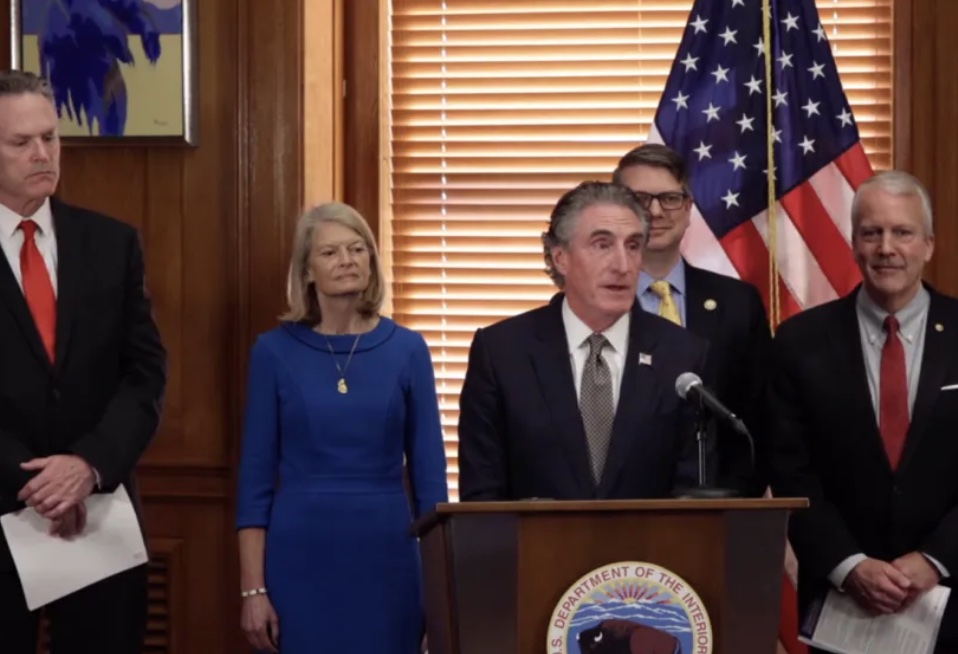
U.S. Department of Interior Sec. Doug Burgum with Gov. Mike Dunleavy, Alaska’s congressional delegation Sen. Lisa Murkowski, Rep. Nick Begich, and Sen. Dan Sullivan, announced several actions advancing resource development projects in Alaska.
The federal government is proceeding with efforts to expand drilling in the Arctic National Wildlife Refuge, mining in northwest Alaska, and construction of a road between King Cove and Cold Bay on the Alaska Peninsula, U.S. Interior Secretary Doug Burgum said.
At an event in Washington, D.C. that was dubbed “Alaska Day” by the federal department, Burgum signed a series of documents pertaining to all three projects as well as an ongoing effort by the federal government to give land to the families of Alaska Native Vietnam War veterans.
“This is our first, this won’t be our last, Alaska Day. We have a lot more things to accomplish, a lot more things to celebrate going forward,” said Interior Sec. Doug Burgum.
“I told the president, it’s like Christmas every morning, I wake up, I go to look at what’s under the proverbial Christmas tree to see what’s happening. And here’s another example of more presents for not just Alaska, but for this country,” said Gov. Mike Dunleavy.
Burgum signed previously announced permits for the 211-mile Ambler Road, which is intended to connect the Dalton Highway with a series of potential mine sites in the Brooks Range of northern Alaska.
He also signed a record of decision for the federal government’s oil and gas drilling program in the coastal plain of the Arctic National Wildlife Refuge of northeast Alaska.
That re-establishes a program that had been in place during the first term of President Donald Trump but which was subsequently reversed by President Joe Biden.
Burgum also reversed the Biden administration’s decision to suspend oil and gas leases issued by the federal government in 2020 to the Alaska Industrial Development and Export Authority.
Barring further litigation, that move clears the way for AIDEA — Alaska’s state-owned development bank — to begin seismic surveys that could reveal the amount of oil available within parts of the Arctic refuge’s coastal plain.
While the Ambler and ANWR actions effectively took the projects back to where they stood in 2020, the King Cove road is now closer to construction at any point in its decades-long development process.
Envisioned as a gravel road between King Cove and an all-weather airport at Cold Bay, the road would pass through the Izembek National Wildlife Refuge, a nationally important bird sanctuary.
Eleven miles of new road are needed to link existing roads to the two towns, but those 11 miles would pass through a wilderness area.
On Thursday, Burgum signed documents that complete a land exchange between King Cove Corp., the local Alaska Native corporation, and the federal government. King Cove Corp. gives up about 31,200 acres to expand the refuge, and in return, it receives the 490 acres of refuge land needed to complete the road.
In a move with more limited statewide impact, Burgum signed paperwork awarding three Alaska Native Vietnam War veterans with 160-acre plots of land under a federal allotment program. As of March, 453 veterans and their families had requested plots authorized under legislation authored by Alaska Sens. Lisa Murkowski and Dan Sullivan.
On the first day of his second term in office, Trump issued an executive order seeking to encourage oil and gas development, mining, and logging in Alaska.
Elected officials said they see Thursday’s actions in line with that decision.
Alaska Republican Rep. Nick Begich said projects like the Ambler Road and ANWR drilling matter because they create jobs.
“We need the jobs. We need high-paying, good jobs, and these resource industry jobs fit that bill completely. And so whether it’s mining, timber, oil and gas development or other resources, these are necessary for the functioning of Alaska’s economy,” said Begich.
The coastal plain of the Arctic National Wildlife Refuge is believed to contain billions of barrels of recoverable oil that could be sold on global markets.
Sullivan noted that previous North Slope oil development has been good for the region’s residents.
“The life expectancy, mostly of the Native people in our state, has increased in the North Slope and the Northwest Arctic Borough and by dramatic numbers … and a lot of that is due to the benefits that come from responsible resource development: jobs, revenues, water and sewer, gymnasiums, health clinics. So it’s a real life and death issue,” said Sen. Dan Sullivan.
The predominantly Alaska Native town of Kaktovik is located on Barter Island, within the refuge.
“Developing ANWR’s Coastal Plain is vital for Kaktovik’s future. Taxation of development infrastructure in our region funds essential services across the North Slope, including water and sewer systems to clinics, roads, and first responders. Today’s actions by the federal government create the conditions for these services to remain available and for continued progress for our communities,” said the town’s mayor, Nathan Gordon Jr., in a written statement.
WHAT COMES NEXT
All three development projects boosted by the federal government on Thursday are a long way from construction, both supporters and detractors say.
In all three cases, proponents need to obtain additional federal permits and will have to cope with lawsuits brought by opponents.
Source: Alaska Beacon
Be in-the-know when you’re on-the-go!
FREE eNews delivery service to your email twice-weekly. With a focus on lead-driven news, our news service will help you develop new business contacts on an on-going basis.
CLICK HERE to register your email address.