




Pennsylvania Examines Options for Cutting Carbon Emissions
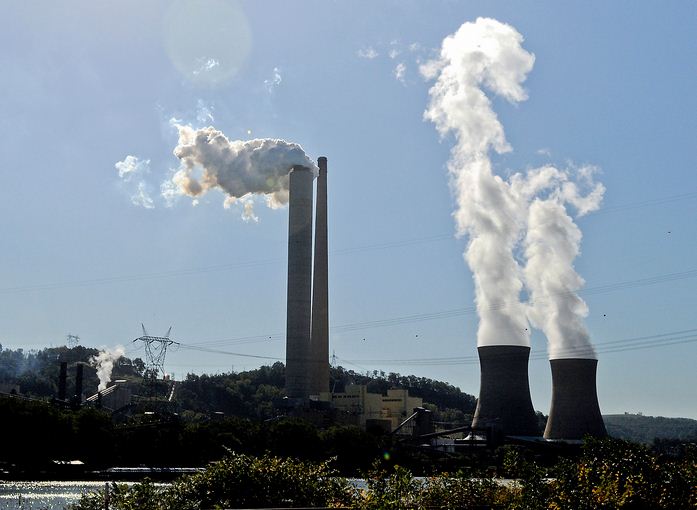
[Click image to enlarge]
In the days after President Obama and the Environmental Protection Agency announced final rules for cutting the nation’s carbon emissions from power plants, Rob Altenburg, director of the environmental group PennFuture’s Energy Center, did a few quick calculations to determine how close Pennsylvania is to meeting its final target, 15 years away.
Based on recent and planned coal-fired power plant retirements and existing state programs for energy efficiency and renewable energy standards, “We’re about halfway there,” he said.
“What’s it going to take to get the other half? There are a ton of options.”
Pennsylvania is not among the states with either the hardest or the easiest paths to compliance with the new rule, which the Obama administration is calling the nation’s most significant effort to curb emissions of the principal gas driving the world’s changing climate.
An analysis by SNL Energy that compared projections of what each state’s emissions rate would have been in 2020 without the Clean Power Plan to its goal in 2030 under the new rule found that Pennsylvania will have to cut its emissions rate by 26 percent from where business-as-usual behavior would put the commonwealth in 2020 in order to meet the EPA’s target.
That puts Pennsylvania in a better position than neighboring Ohio or West Virginia, which will have to cut carbon emissions rates by 32 percent and 35 percent, respectively, from where they are expected to be in 2020 under current trends, the analysis showed. But it leaves Pennsylvania with a much harder task than neighboring New York, which is projected to be below its 2030 goal by 2020 by following through on practices that are already planned or in place.
NUANCES OF COMPLIANCE
“On the face of it, our target doesn’t look that different” from the proposal EPA announced in June 2014, said Kevin Sunday, manager of government affairs at the Pennsylvania Chamber of Business and Industry. But that doesn’t mean Pennsylvania’s path to compliance will be easy or that every option for meeting the EPA’s target will be equal, he said.
“The question isn’t really are we going to have less carbon emissions in the future. We’re going that way anyway,” he said. “The question is how painful and expensive is the government going to make it on ratepayers and industry.”
Mr. Sunday said it is “reasonable to expect” that Gov. Tom Wolf’s secretary of policy and planning, John Hanger, a former state Department of Environmental Protection secretary and a former president of PennFuture, will have a central role in developing the state’s plan and is likely to pursue an aggressive strategy for adopting more sources of renewable energy.
“But renewables are the most expensive way to reduce carbon emissions,” Mr. Sunday said. EPA’s rule estimates that it will cost $23 for each ton of carbon dioxide reduced by running coal-fired power plants more efficiently; $24 per ton reduced by burning natural gas instead of coal in power plants; and $37 per ton reduced by adopting renewable power sources, like wind and solar.
“The governor’s office should develop a plan that keeps costs as low as possible for consumers, and shame on them if they don’t,” Mr. Sunday said.
The lowest-cost option, Mr. Altenburg of PennFuture said, is for Pennsylvania to join with other states in crafting a carbon-reduction strategy. A multi-state program could be about 30 percent cheaper, he said, than Pennsylvania pursuing its goal alone.
If Pennsylvania strikes out on its own, there are opportunities to cut emissions through programs that already exist, he said. The commonwealth is “nowhere near our cost-effective potential for energy efficiency” under its current Act 129 program, which requires Pennsylvania’s largest electric utilities to reduce energy consumption and demand. And the state Alternative Energy Portfolio Standard, which requires Pennsylvania to get 8 percent of its electricity from renewable sources by 2020, makes renewable energy a smaller share of Pennsylvania’s energy mix than it is in other states.
AN EXTENDED PROCESS
Pennsylvania plans to take time, and lots of public comment, before it decides on a strategy.
In the final version of the rule, EPA has made it easier for states to get up to a two-year extension — from September 2016 until September 2018 — to develop their individual carbon reduction plans. The rule also gives states until 2022, rather than 2020, to start meeting their interim targets.
A state DEP spokesman said no decisions have been made yet about whether to seek the extension.
“We will have a draft plan prepared by September 2016, as required by the Clean Power Plan, and will determine whether to request an extension as we progress in the planning process,” DEP press secretary Neil Shader said. “Our priority is creating a plan which works for Pennsylvania, and incorporates the views of a variety of stakeholders including the legislature, industry and citizens.”
A Pennsylvania law enacted in October 2014 requires DEP to submit its plan to the General Assembly for approval at least 100 days before the department sends it on to federal regulators. But it is unclear whether the grace period in the new version of the rule will affect the General Assembly’s oversight or DEP’s timing, since a potentially contradictory section of the 2014 law calls for DEP’s plan to be approved by default and immediately submitted to the EPA if either chamber of the Legislature does not vote on it before June 15, 2016 — well before DEP is likely to have finalized its strategy.
Mr. Sunday of the Pennsylvania Chamber, which was among the groups advocating passage of the law, said that detail of the law “is something that might need to be revisited, but it needs to be analyzed first.”
He said it is clear that Pennsylvania should take the time it is given to come up with a plan that keeps electric rates as low as possible.
“It’s a good thing that we have a little bit of extra time,” he said. “But it will be very challenging and costly to get to where EPA wants us to be in 2022 and moving forward.”
— By: Laura Legere, Pittsburgh Post Gazette