




Northeastern University Identifies Efficient Method of Extracting REEs from Mining Waste
ChE/COS Assistant Professor Damilola Daramola developed a method using chemical treatments and microwave reactors to extract rare earth elements from coal tailings two to three times more efficiently than standard approaches.

[Click image to enlarge]
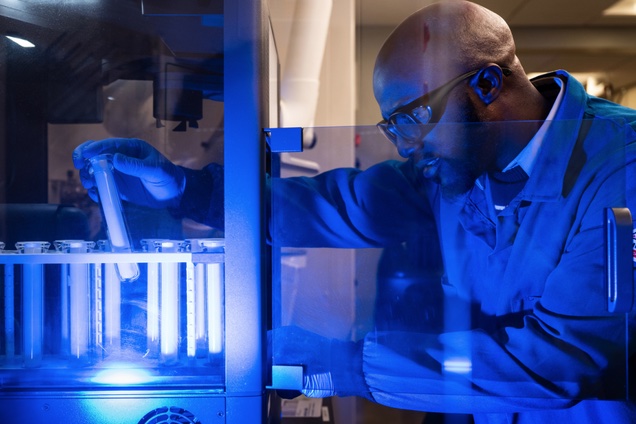
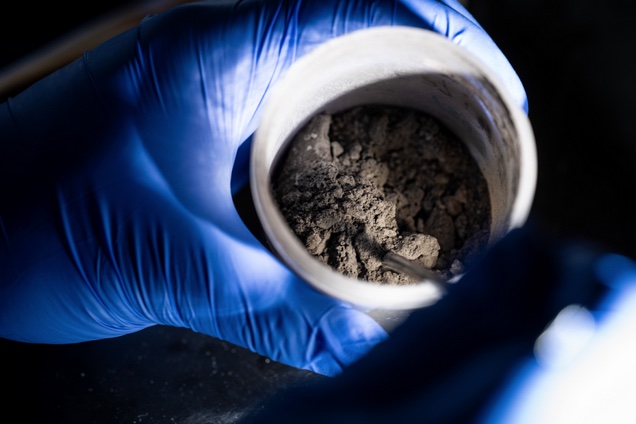
Damilola Daramola used a chemical solution and specialized microwave reactor on samples of coal tailings to extract rare earths.
[Click image to enlarge]
Photos by Alyssa Stone/Northeastern University
[Click image to enlarge]
New Northeastern University College of Engineering research has identified a method of extracting rare earth elements from the mining waste product that is two to three times more efficient than previous approaches.
Rare earth elements are an easy-to-find, hard-to-refine resource critical for everything from magnets and electronics to batteries and catalysts for chemical reactions. Since the 1980s, a race has been on between the United States and China for dominance of the rare earth element market — and the United States is losing.
New research out of Northeastern University has discovered a new way to extract rare earth elements out of coal tailings, the cast-off soil and rock left behind by coal mining. Using a chemical treatment and a specially designed microwave reactor to control the temperature, the researchers have doubled the extraction levels previously possible.
Rare earth elements, often just called rare earths, aren’t really all that rare, according to the Science History Institute. Rather, in nature, they appear mixed with other elements, sometimes radioactive ones, making them difficult to refine.
Damilola Daramola, an assistant professor in the departments of chemistry and chemical biology, and chemical engineering at Northeastern, says rare earth elements are often made accessible as byproducts of other mining operations. For his purposes, that means coal.
Burning the carbon in coal leaves behind an ash of inorganic compounds, often called fly ash, which Daramola says has been well-studied for rare earths. But coal tailings, the mountains of unwanted detritus left behind by coal mining, remain an underused resource, partly due to the ready availability of fly ash and partly due to the fact that there is simply all that organic material still left to sift through in the tailings, he continues.
By pretreating the coal tailings in a solution of water and sodium hydroxide, or lye, and then bathing them in nitric acid while controlling the temperature of the reaction through a specialized microwave reactor, Daramola and his team found that they could extract rare earths two to three times more efficiently than in the standard methods used on coal byproducts.
“That combination, of being able to thermally stimulate the material, alongside the treatment with sodium hydroxide. Well, it turns out that what you’re doing is actually changing the solid structure of this material and allowing for the extraction of valuable rare earths,” said Daramola.
Daramola and Northeastern Ph.D. student Lawrence Ajayi, the first author of the study, say that the rare earths they extracted have a diverse range of applications. Neodymium, Ajayi gives as one example, is “the third-most abundant element in the tailings, and it happens, also, to be very important for energy,” being found in high-powered magnets and the motors for both electric vehicles and wind turbines.
Be in-the-know when you’re on-the-go!
FREE eNews delivery service to your email twice-weekly. With a focus on lead-driven news, our news service will help you develop new business contacts on an on-going basis.
CLICK HERE to register your email address.
Copyright © 2026 Mining Connection LLC. All rights reserved. This material may not be published, broadcast, rewritten, or redistributed without permission.
For licensing permission, .(JavaScript must be enabled to view this email address)