




Latest Mine Rescue Technology Unveiled at MSHA Facilities in Pa.
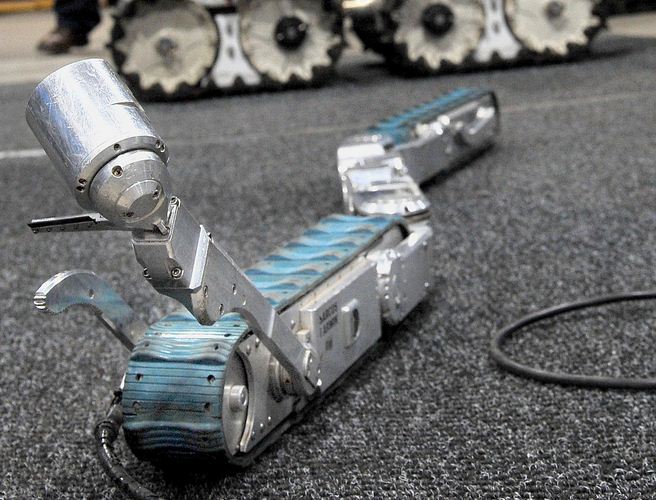
The snake robot fits into a 4-inch-wide bore hole to gather information needed in a mine rescue. (Photo: Pam Panchak)
[Click image to enlarge]
A new seismic technology system that can digitally pinpoint trapped miners. A better communications system among rescue workers who previously had to play a game of telephone.
A “snake robot” that can slither down a 4-inch-wide bore hole to gather information, and a 600-pound robotic vehicle whose mechanical arm can physically move a person or debris out of a mine.
These are the most developed advances in mine rescue after eight years of research and development at the Mine Safety and Health Administration, which showed off the technology Thursday to a crowd of media and officials at its facilities in South Park.
The pursuit of modern rescue equipment began at the agency under the direction of Joseph A. Main, who took the reins of MSHA in 2009.
At that time, the arsenal of resources available to the Arlington, Va.-based agency, which is tasked with preventing deaths and injuries in the nation’s mines, was not pretty. Obsolete equipment and technology were undermining rescue efforts and leading to long response times when disasters did occur, Mr. Main said.
Today, the agency has added 23 emergency response trucks to its fleet and revamped its seismic system, and it can use at least three different robotic vehicles that can be driven remotely by an Xbox game controller.
Kevin Stricklin, MSHA administrator for coal mine safety and health, said he remembers the procedure for monitoring gases during a mine fire in the 1980s. He had to write down readings from equipment measuring methane, oxygen and carbon monoxide levels coming out of the mine and drive them to the command center. Then, hopefully, he would make it back to the equipment in time to grab the next 15-minute reading.
The readings are critical for emergency responders to decide where specifically to send rescue teams underground and to determine where it is safe, Mr. Stricklin said.
“The technology is leaps and bounds beyond anything I ever imagined 37 years ago, sitting in that station wagon wondering if my numbers would make it down there in time for them to make a decision on what to do,” he said. “That’s what all this equipment does for us. It gives us a real-time snapshot of what’s going on.”
The robotic vehicles displayed Thursday were equipped with cameras and gas detection sensors. They’re varied in size and purpose.
The 600-pound robot, manufactured by Virginia-based Remotec, is good for moving large objects and can withstand dangerous gases and explosions.
The robotic snake is nimbler, consisting of seven joints that bend and rotate in more than a dozen configurations. For example, the “follow the leader” mode sets the tail of the snake to follow the head — making it automatically slither in tight areas. It’s manufactured by Salt Lake City-based Sarcos.
Meanwhile, new digital equipment replaces the seismic locator system engineered in 1970 and the dated, analog components, said Maxwell Clark, an engineer with MSHA.
When a person pounds on the roof of an underground mine, the system shows the impacts on red, blue and green seismic feeds and triangulates it. The system can detect movements as deep at 1,300 feet, Mr. Clark said.
Emergencies are rare, Mr. Stricklin said, but require constant preparation. The agency announced this month that the number of mining deaths in 2016 dropped to 25, the lowest level ever recorded since the agency started tallies in the late-1970s. Of those, nine occurred in U.S. coal mines, also the lowest recorded number.
The decline in deaths is due to improved response times as well as new regulations, better inspections and enforcement, the agency said in a news release. Currently, about 330,000 miners work in more than 13,000 U.S. mines.
Before a demonstration of the equipment, Mr. Main spoke in front of one of the new blue mine emergency vehicles that serves as the ground base for rescue operations.
Looking forward, he said, the agency hopes to roll out cameras and voice communication equipment in helmets for response crew members as well as a reliable Wi-Fi connection for the emergency vehicle so crew members can use less bulky tablets.
“We must not be lulled into the belief that the era of mine disasters is over,” Mr. Main said. “We have to be ready for them. We still have much more work to do.”
Source: (January 6, 2017) Pittsburgh Post-Gazette
Be in-the-know when you’re on-the-go!
FREE eNews delivery service to your email twice-weekly. With a focus on lead-driven news, our news service will help you develop new business contacts on an on-going basis.
CLICK HERE to register your email address.