




Mining Oregon’s Gemstone
[Click image to enlarge]
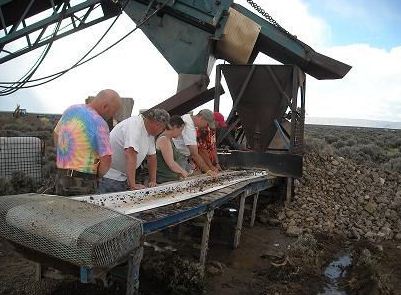
A fun alternative to digging in the dirt for sunstones, vistors can pick gemstones directly from the conveyor belt.
[Click image to enlarge]
It may not have the historic allure and Americana nostalgia of the great gold rush, but tucked away in a quiet corner of Lake County is a place where novice and expert collectors alike work side-by-side in pursuit of one of the most unique and rare gemstones — the Oregon Sunstone.
Declared the official gemstone of Oregon by state legislative decree in 1987, sunstones stateside are only found in specific parts of Pennsylvania, North Carolina and the small nook known as the Plush Sunstone Mining Area in Oregon. They have also been discovered in Norway and Siberia, and a commercial mining operation also exists in neighboring Harney County.
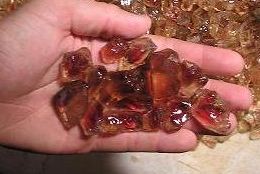
Sunstones are a rare volcanic creation, a feldspar crystal formed in lava infused with copper, then covered by water. An eruption of the Steens Mountains estimated to have occurred around 14 million years ago created Oregon’s lone deposit of these identifiable gem stones, the area being below a vast lake for thousands of years until eventually drying up and revealing loose stones. The result is a gemstone that can appear orange, red, green or transparent, though they are most commonly found with a yellow or orange-ish hue, hence the sunstone moniker.
Gaining the nickname “Plush diamonds,” sunstones were collected and used by Native Americans, and eventually gained favor by white settlers as well. The area where sunstones can be found covers approximately 7 square miles in the Rabbit Basin of Warner Valley sandwiched between Lake Abert and the Hart Mountain National Wildlife Refuge, about 25 miles north of Plush.
As interest in sunstones grew, in 1970 a collective of avid collectors discovered a method of retrieving larger more-intact sunstone deposits, and multiple mining claims were established. Today around 370 claims exist. In a somewhat unusual move, the Bureau of Land Management assured the mining area wouldn’t be completely privatized, removing roughly half of the sunstone mining area from private claims to establish a public collecting area. Roughly 20 acres of private mining claims are scattered within the public collection area.
In addition to the public collection area, several of the private mining claims allow collecting on-site for a base fee. Mechanized digging equipment is prohibited, but shovels and picks are encouraged for a day of sifting through rocks seeking out sunstones. While there are no fees for collecting sunstones within the public collecting area, they may not be collected for trade or commercial purposes. For those seeking to profit off their discoveries, several of the private claims permit collections on their portion, for a base use fee.
The site has become a popular stop for regional rock hounds, school field trips, and curious travelers trying their luck at finding a real gem among the debris. Amenities are at a bare minimum on-site, though camping is available, so visitors are strongly encouraged to dress appropriately and bring plenty of water. The land may seem inhospitable, but wildlife is common, from roaming antelope to jumping jackrabbits.
For local rock hounding clubs in Lake and Klamath counties, the Plush Sunstone Mining Area is — pardon the pun — the gem of locales to visit. The Tallman Rock Chippers, Lake County’s regional collective of rock and mineral collectors, make routine field trips to the site, and coordinate trips for the uninitiated during their annual Jewelry and Gem Show. This year’s Tallman Rock Chippers show is set for Saturday and Sunday, May 20-21 at the Lake County Fairgrounds.
Klamath County’s equivalent, the Klamath Rock and Arrowhead Club, also coordinates trips to the site, albeit a much longer trip — a testament to the inherent value found on-site in the search and discovery experience of seeking out Plush diamonds. At their annual Rock, Gem and Mineral Show, held in March annually at the Klamath County Fairgrounds, Plush sunstones are among the most popular items on display from vendors.
But the collection area’s appeal, as remote as it may appear, is a huge draw beyond local experts. Tourists commonly come from hundreds of miles away for a day of digging. Spectrum Mine, Double Eagle Mine, Dust Devil Mine and several others encourage digging on their private sites for a fee, though alternately visitors can often sift through unprocessed soil and piles for free on the hunt for sunstones that may have been missed by the mining operations. Dust Devil Mine allows free digging, but charges a percentage of the wholesale value of whatever is collected.
At the Spectrum Mine, for an hourly fee, tourists can pick sunstones directly off the belt as mechanized screens sift away dirt and debris. While this garners a higher fee, the amount of sunstones typically retrieved by day-trippers tends to equal that of three to four days spent digging free-hand, making it worthwhile for the passive novice giving it a go on a whim.
While sunstones are growing in popularity for jewelry due to its easily malleable structure, that also is a drawback. As a softer gem compared to diamonds, rubies, sapphires and topaz, sunstones are more susceptible to scratching. Still, value is there, and with an expert cutter handed a quality raw stone, a small stone’s value can go from $1,000 to $15,000. Most stones though are valued around $5 to $10 a carat, though rarer red and green ones can be 10 times as valuable.
A word of caution to those excited to start digging in the dirt, though, as the site can be difficult to reach on good days for its dry, unpaved roads. During times of bad weather, the mud makes it nearly impossible to reach, leaving the mining area serviceable only during certain times of year.
The arduous trek to reach the site and labor needed once on site doesn’t deter the adventurous, with BLM estimates placing annual visitors to the site around 10,000 per year. Grab a shovel, and give it a go.
- By: Kurt Liedtke, Herald and News